

Articles/ By The Fossil Centre
For many South Africans, time spent in the Karoo is fleeting whilst travelling between major centres. What many do not know is that the rocks of the Karoo basin provide the most complete documentation of the evolutionary development of early mammals in the world.
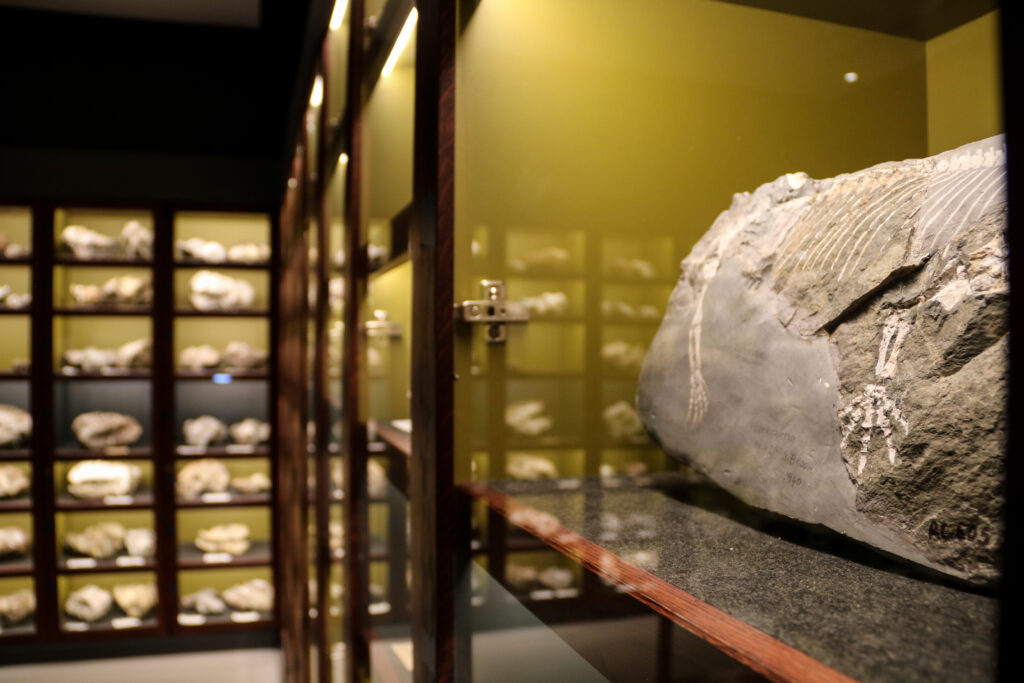
Professor Bruce Rubidge was born with palaeontological research in his blood and has spent most of his adult life conducting research on the Karoo basin and its rich history. He is the curator of the world-renowned Rubidge Collection that was amassed in the 1930’s by his grandfather Sidney Rubidge, a Karoo farmer, with the help of Dr Robert Broom and Professor James Kitching.
The Rubidge Collection has resulted in more than 3000 palaeontological research publications and is of great international importance as it contains 120 type specimens. A type is the first described specimen, and the reference specimen, of a species and as the continents were joined when these animals lived these fossil species have global distribution.
Until recently, the Rubidge Collection was housed on the Rubidge farm, Wellwood, situated some 30 kilometres north of Graaff-Reinet. However, the collection has been moved to the Karoo Origins Fossil Centre in Graaff-Reinet that will open to the public in 2025.
To truly understand the value of the Rubidge Collection, one should understand the importance of the Karoo basin from a palaeontological perspective.
The information provided below is an extract from an academic article titled: The Karoo, a Geological and Palaeontological Superlative: Economic Potential of Deep History. The article was written by Professor Rubidge during his tenure as the Head of the Bernard Price Institute for Palaeontological Research, University of the Witwatersrand.
The Karoo, a Geological and Palaeontological Superlative: Economic Potential of Deep History
The rocks of the Karoo basin of South Africa preserve one of the most remarkable and extended sequences of terrestrial tetrapod development from the Permian to the Jurassic and provide the most complete documentation of the evolutionary development of early mammals in the world.
In addition, they provide a record of the evolving palaeoenvironments in which these changes in biodiversity occurred and record the devastating effects of the “mother of all mass extinctions” (Erwin 1994) and the subsequent biotic recovery. Although similar geological successions are present in India, China, and Russia, they are not as complete (Rubidge 2005). The global significance of the Karoo Supergroup lies in its representation of the most complete Permian-Jurassic sequence having implications for global biostratigraphic and correlative studies. This fragile heritage has unique opportunities for palaeotourism and job creation, if responsibly managed.
Rocks of the Karoo Basin preserve a world class assemblage of fossils which document the early evolution of tortoises, dinosaurs and mammals. These rocks, deposited over an extensive period from the Late Carboniferous (300 million years ago) to the Early Jurassic (180 million years ago), witnessed environmental change from glaciers, through aeolian desert dunes, and culminating in vast outpouring of volcanic lava.
This is the only place in the world where such an extended fossil record of early evolution of “reptilian” life is preserved in a single basin, and chronicles the most distant evolutionary ancestry of mammals in remarkable detail. Apart from being a pivotal area for the study of early “reptile” biodiversity and evolution, it also offers great potential for palaeotourism and job creation if properly managed, but could lead to irreparable damage to this precious heritage resource if exploited inappropriately.
Because of the unique antiquity of its geological record, South Africa is the single country in the world which has: the oldest evidence of life on Earth; the oldest multicellular animals; the most primitive land-living plants; the most distant ancestors of dinosaurs; the most complete record of the more than 80 million year ancestry of mammals; a remarkable record of human origins and of human achievements through the last four million years. In fact, it is not possible to write a comprehensive text on the development of life on earth without referring extensively to the South African fossil record. In recognition of this, the South African Government identified Palaeontology and Palaeoanthropology as one of five key research themes in its National Research and Development Strategy of July, 2002.
Many of these superlatives are centred on the rocks of the Karoo Basin which span a time period from the Late Carboniferous (300 million years ago) to the Early Jurassic (180 million years ago) and preserve a world class assemblage of fossils which document the early evolution of tortoises, dinosaurs and mammals. During this time the environment changed from a landscape covered by glaciers, through an inland sea, progressively arid fluvial deposition, aeolian desert dunes, and culminating in vast outpouring of volcanic lava.
Hi
I recently acquired a collection of rocks , with some fossils, i was wondering if you would be able too help identify them for me
Many Thanks for your consideration
Lennard Hammerschlag