

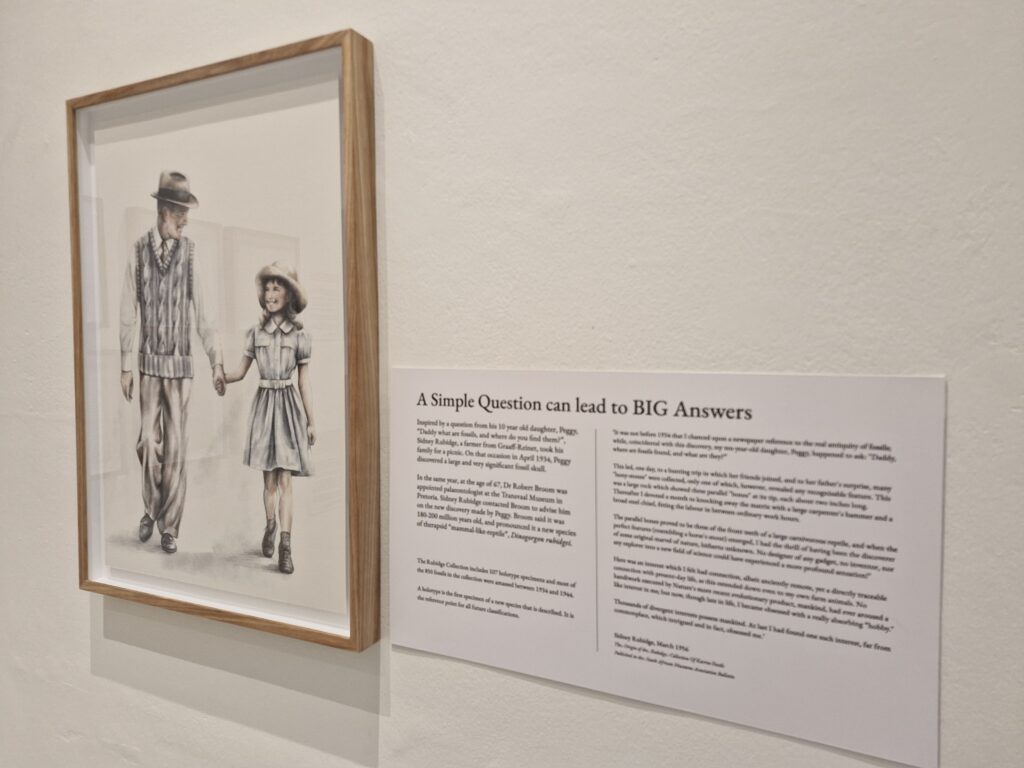
In 1934, when ten-year old Peggy Rubidge asked her father “Daddy, what are fossils?”, Sidney Rubidge who himself had been educated by his own father on the existence of fossils dating back thousands of years, could not have imagined that in responding to his daughter’s curious mind he would make one of the most prolific finds in South Africa’s palaeontological history.
A spontaneous family picnic resulted in the discovery of the remarkable complete 30cm long skull ofa large flesh-eating mammal-like reptile which was described as a new species, Dinogorgon rubidgei, by internationally acclaimed palaeontologist Dr Robert Broom.
The find sparked a lifelong passion to search for more fossils and today the collection comprising more than 850 fossil skulls, of which 120 are type specimens (the reference specimens of a newly described species), is of international importance.
This collection which has been curated by four successive generations of Rubidge farm owners, has recently been moved from the Rubidge farm, Wellwood in the Graaff-Reinet district, to its new home in Graaff-Reinet itself.
Through generous sponsorship, a suitable property was procured in Parsonage Street comprising two buildings dating back to 1902 and together provide the 900 square metres required for exhibition, public outreach and research purposes. The physical location of Karoo Origins in Parsonage Street is ideal as the street possesses significant heritage value.
According to Professor Bruce Rubidge, the current curator of the Rubidge Collection and one of South Africa’s most highly respected palaeontologists, “This decision was made to demonstrate the riechness of the Karoo fossil record by displaying the entire collection. This is different to the approach to most museums where many of the specimens are stored in inaccessible cases This centre dislpays the entire collection in specially designed caseswhich facilitate eay removal for study purposes and maintenance.
The display cases, that house the entire Rubidge Collection, have been designed to facilitate removal of specimens for research, as well as to enable easy changing of light bulbs.
The formidable task of moving the collection to its new home was undertaken by three Karoo Origins staff over a period of 14 days. Each fossil was individually wrapped, labelled and securely packed in boxes, and each day a truck load was transported from Wellwood to Graaff-Reinet.
On arrival the fossils were unpacked into the newly installed exhibition cases. Careful documentation of each fossil leaving Wellwood was essential, then the exact placement of each specimen in the new cases was carefully recorded.
This would ensure easy retrieval of specimens needed for research.
Karoo Origins – The Fossil Centre opened to the public in April 2025 providing visitors an exciting opportunity to look through a window into the rich palaeontological history of the Karoo.
Fascinating. We are driving home to Hermanus from a Karoo Farm on 29th September and will visit. It is on my “to do” list.
There is a fossil bed on the farm which I love looking over. The fossils are all small. We are overnighting at the Karoo National Park and look forward to seeing those fossils again.
There are some errors in the text “Daddy, what are fossils….” I am a copy editor and if you send me the text as a Word doc it would be my pleasure to correct it (obviously no charge!)
kind regards
Ivan McKeag